.png)


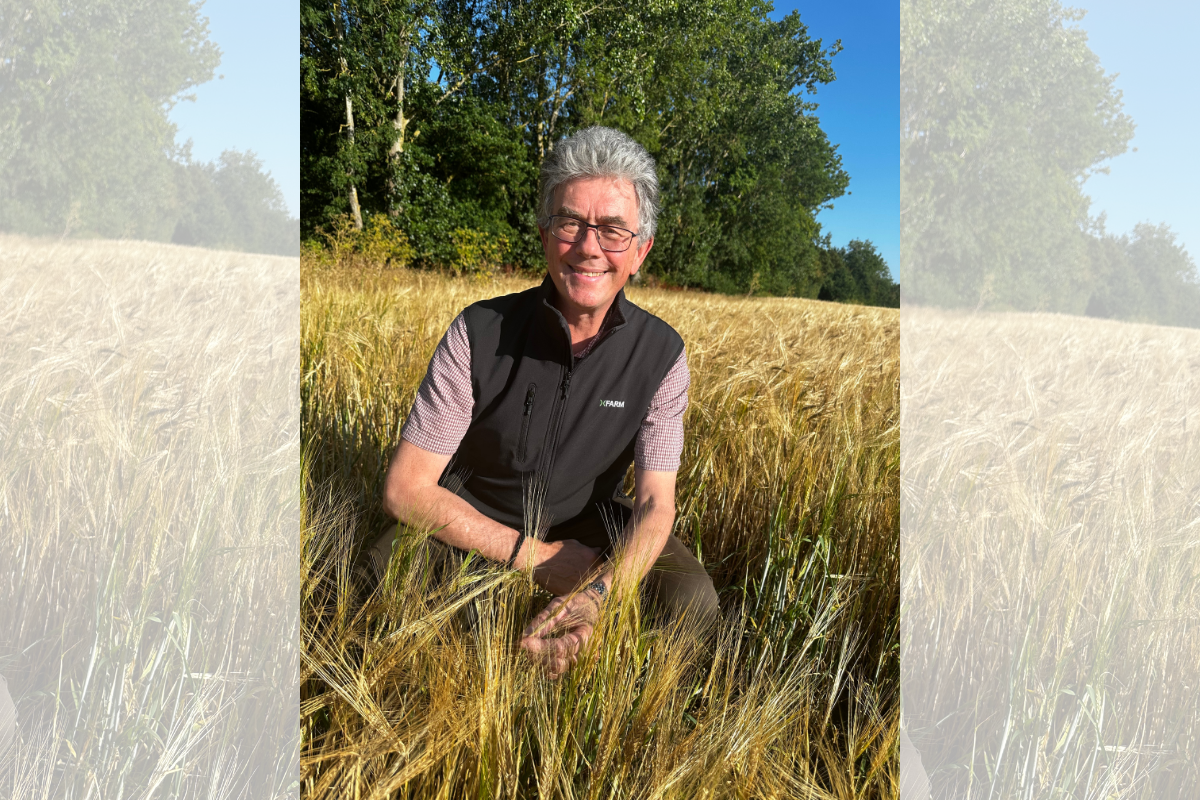
Richard Anscombe has just taken on the role of UK Country Manager at xFarm Technologies, and his background makes him uniquely suited for it: twenty years in UK IT followed by leading a major farming cooperative. We spoke with him about trust, data, and why the UK market is ready for xFarm.
My roots in agriculture go back to childhood, growing up in the Cheshire countryside among farmers' sons and working weekends on a local farm from the age of eleven. That early grounding led me to Harper Adams, where I studied Agricultural Marketing and Business Administration, met my wife Penny, and began a career spanning Norsk Hydro, a software venture I helped commercialise, and ultimately the CEO role at a major UK buying cooperative — before founding my own consultancy in 2019 and now joining xFarm.
Outside of work, I've always believed in giving back: I spent years growing and chairing a local youth football club, and served as Chair of our parish council. Penny and I are keen sportspeople — skiing, surfing, cycling, and paddleboarding — and I recently built my own wooden paddleboard and surfboard by hand. I remain based in Suffolk, where I'm a Liveryman with the Worshipful Company of Farmers — a connection xFarm now proudly sponsors.
I spent around 20 years in IT in the UK as a Commercial director of two local software companies often attracting Agriculture and Food companies due to my education and practical working within the Agricultural sector. I became CEO of a large UK based buying group cooperative in 2010 where my knowledge of IT and of Farming was a key factor.
Cooperatives are owned by their farmer members, so the strategy must focus on understanding their business needs and where you can add the most value. That means staying close to them, understanding what matters to them, and involving them actively in the cooperative. Creating an environment where farmers see you as working alongside them is a key differentiator for cooperatives.
First of all, you must understand what matters to farmers, and where their challenges and opportunities are. Secondly, you should focus clearly on how you can meet their needs and make their life easier. The key is stressing that good software can provide relevant information, which is of real, practical business benefit to them. Showing how it saves them money or helps streamline operations is crucial.
Farmers need really good data to make sure that they and their advisors can make informed decisions. I saw xFarm as filling a gap in the UK market with its cloud based as opposed to on premise availability being key, meaning integration with machinery, sensors, weather station and other sources of important data was available or feasible. The fact that xFarm is independent and started by farmers was also important. I saw a real appetite in expanding their European coverage into the UK and saw myself being well placed to assist.
UK farmers have been used to using farm management software for around 20 years, so they clearly see the benefit. UK farmers also use a wide cross section of professional advisors, from Agronomists, Land Agents, to Accountants and Solicitors. These professionals completely understand the need for really good data to aid the assessment of business performance, as well as the decisions to change practices to become more sustainable and improve financial performance. This is especially important as the old subsidy regimes are no longer in place. Many farmers and professional advisors value independence, which is something that xFarm can offer the market.
It makes an enormous difference. With everything in the cloud and connected, farming operations, such as cultivation, crop protection and harvesting are automatically recorded. No more struggling with having to manually input records into outdated systems. Having automatically recorded tasks and their costs you can see down to a field level all operations and the gross profit of that crop. xFarm offers a very different way of managing your operations, saving time and giving valuable insights in one place.
Using xFarm will significantly reduce administration tasks as so much is automated. By capturing all operations, we can give very accurate CO2 equivalent emissions data down to field level, including all operations from tillage to the crop leaving the farm. This means that the actors along the supply chain can start with the most accurate figures possible, down to an individual field if they wish, though most likely down to crop level.
I would say, just take a look in, the knowledge that what they will see will change their minds!
We have the opportunity to become the predominant player in the market with the broadest offering and true independence. We seek to build relationships with the professional advisor community, as mentioned above, who can encourage their farmer clients to adopt xFarm.



.svg)