187 farms, four crops, and one of the most extensive agronomic monitoring networks in Italy: the collaboration between Conserve Italia and xFarm Technologies, together with the University of Bologna, to transform data collected in orchards into measurable decisions regarding irrigation, pest control, and yield estimates.

Conserve Italia is one of Europe’s largest agri-food cooperatives. Its fruit supply chain encompasses four crops—peaches, pears, apricots, and apples—grown by member farms located primarily in Emilia-Romagna, with some also in Puglia, Veneto, and Molise.
Managing a fruit and vegetable supply chain means dealing every year with a variable that no company can control: the weather. Increasingly adverse weather conditions—late frosts, floods, and drought-stricken summers—affect yields, water consumption, and the severity of pests and diseases, with direct impacts on production and costs.
To address this variability, reliable and comparable agronomic data collected directly in the field were needed. Without a structured data base , this became challenging:
• measure the actual irrigation needs of each crop and field;
• assess the phytosanitary risk on a daily basis, not once a week;
• estimate yields in advance to plan for harvesting and processing;
• report on agronomic and environmental results throughout the supply chain.
The goal shared with xFarm Technologies was clear: to equip the supply chain with an infrastructure capable of transforming what happens in the orchards into information that can inform decision-making.
The collaboration between Conserve Italia and xFarm Technologies began in 2024 and is carried out in partnership with the University of Bologna. It is now in its third season and consists of three complementary lines of work.
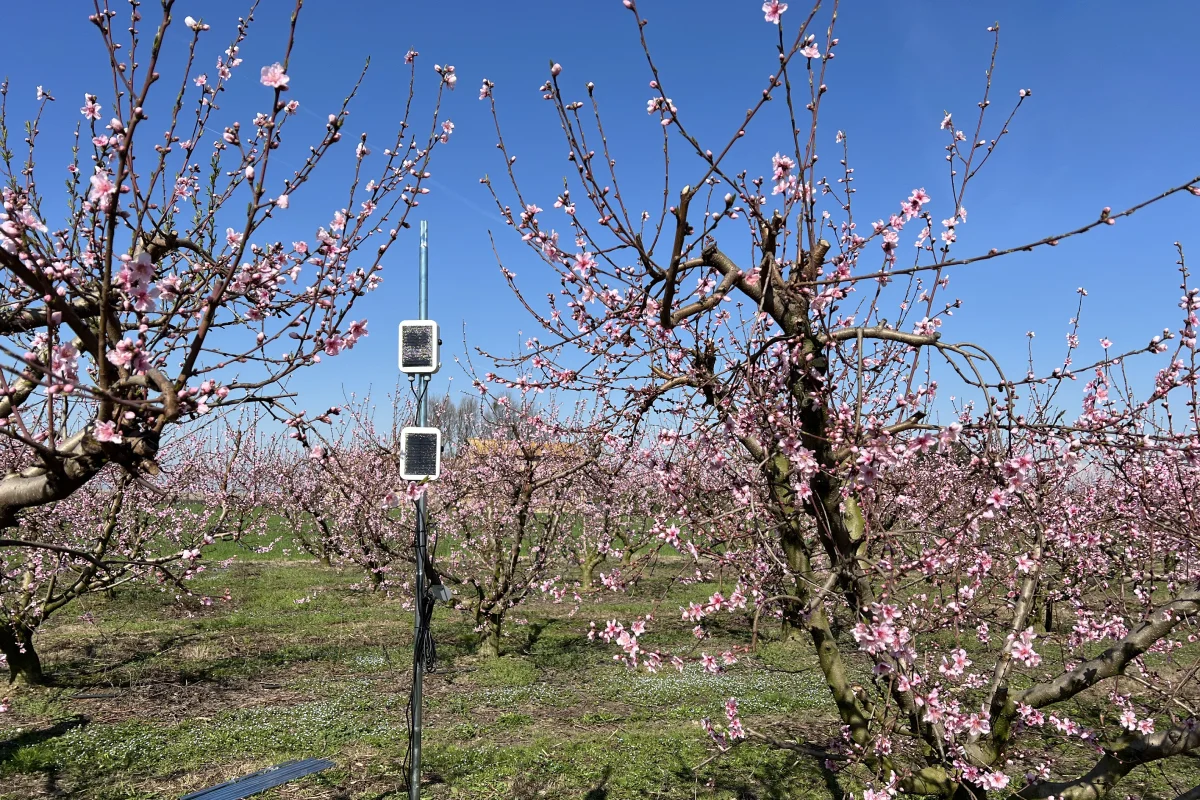
An extensive network of weather stations and field sensors that feeds real-time agronomic data to the xFarm platform—now one of the largest active agronomic monitoring networks in Italy. Each farm has been equipped with hardware and trained in the use of the platform through both online and in-person sessions.
In a group of pilot companies, strategies based on sensor data and models are compared with traditional management practices, measuring the actual effects on irrigation, pest control, and insect monitoring.
A pilot project featuring a computer vision system—developed in collaboration with the University of Bologna—that counts the fruit based on images collected in the field and estimates the yield throughout the season.
During the 2025 growing season, the DSS models— xFarm —were systematically compared with the Emilia-Romagna Region’s weather bulletins: 6 models— xFarm —were compared with 16 regional bulletins and 79 zones, across four crops, from May through August.
The key difference is the time resolution. The regional bulletin is published once a week: in the six days between one publication and the next, an infectious event can emerge, reach its peak, and begin to decline. The DSS xFarm updates the risk every 24 hours and, on average, signals an infectious event 4 days earlier than the first official announcement.
Where the comparison is methodologically sound—epidemiological models versus models—the agreement rate reaches 94% (15 agreements or partial agreements out of 16). Furthermore, by identifying windows of low infectious pressure within periods classified as “high risk” by the regulations, a farmer guided by the DSS would have avoided 2–3 fungicide treatments per crop between May and July. In particular, there were potential savings on the cost of plant protection products for pear and peach trees, as well as a potential reduction in the environmental impact.
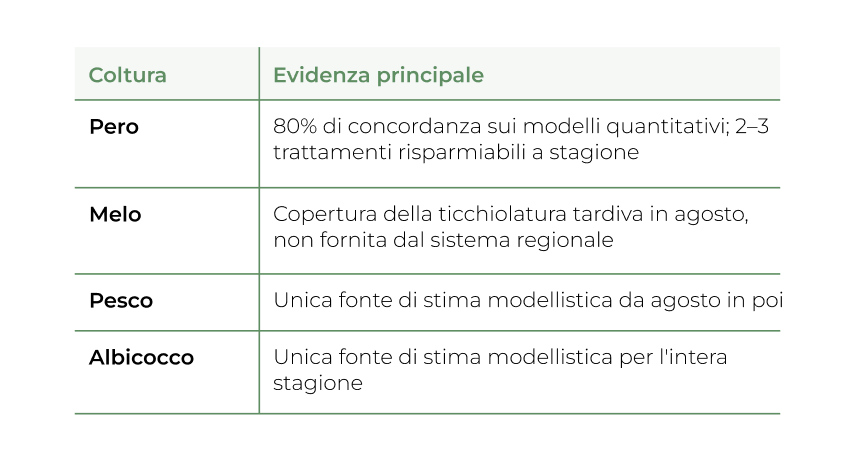
The purpose of the DSS is not to replace the regional bulletin, but to complement it: xFarm serves as a daily operational guide, while the bulletin serves as a regulatory reference for integrated production.
At the end of the 2025 season, the project includes:
In addition, the FarmView pilot project made significant strides between 2024 and 2025: fruit recognition accuracy increased from 56–66% to 76–81%, with approximately 40,000 images collected in the field, and a yield estimation error of 2.5% for pear trees and 4.3% for peach trees, calculated by integrating three years of historical data. For apricot trees, variability remains higher due to extreme weather events, while the 2026 roadmap calls for the integration of meteorological data and vegetation indices to strengthen the model.
These initial experimental results contribute to the ongoing process of innovation that xFarm aims to bring to the Conserve Italia supply chain.
The analysis highlighted a principle that applies to the entire fruit and vegetable supply chain: given the same information, those who receive it first make better decisions.
A four-day lead time on the alert signal means more effective treatments, less waste, and decisions based on current data rather than on data from the previous week. And during periods when the actual risk is low, being able to distinguish between the precautionary threshold and an ongoing infectious event helps avoid unnecessary treatments.
Agronomic data, therefore, are not merely a monitoring tool. They become a concrete source of " base " to guide on-farm decisions and support farms on their path to improvement.
Conserve Italia's partnership with xFarm Technologies continues.
The third season of the project aims to consolidate the results of the pilot study, refine the yield estimation model by incorporating meteorological data and vegetation indices, and strengthen the supply chain reporting tools.
The system developed by Conserve Italia in partnership with xFarm Technologies is more than just a network of sensors. It is a digital infrastructure that collects data directly from orchards, assesses risks every 24 hours, compares agronomic strategies, and measures results over time.
A fruit and vegetable supply chain can become measurably more resilient and efficient. But to do so, it must first be able to transform what happens in the field into reliable data.
The best decisions aren't made on the fly. They're carefully considered.
“In agriculture, the quality of a decision depends on the timeliness of the information on which it is based. The project developed with Conserve Italia and the University of Bologna applies this principle to a fruit and vegetable supply chain: a network of monitoring tools, predictive models, and scientific expertise integrated to assess the condition of orchards on a daily basis. This is how digitization contributes to the agri-food supply chain: by reducing uncertainty—starting with climate-related uncertainty—and guiding agronomic decisions based on measurable evidence.”
Giovanni Causapruno, Revenue Director for Europe at xFarm Technologies
“The Agrometeo project was launched with the goal of transforming experimental research into increasingly reliable and practical technological tools, strengthening the link between data, research, and cooperation, so as to guide the members of our supply chain toward digitalization, enabling them to make more informed and timely decisions in the field.”
Mattia Onofri, Head of the Fruit Division at Conserve Italia